
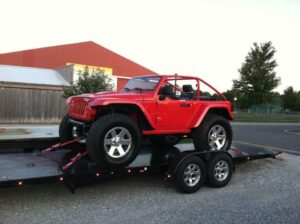
Choosing the right trailer can make a major difference in how easily, safely, and efficiently you transport vehicles or equipment. Rollback, tilt, and traditional car haulers can all get the job done, but their loading methods and ideal applications differ. Understanding those differences can help you decide which design best fits your hauling needs.
Understanding Traditional and Tilt Car Haulers
A traditional car hauler typically uses a fixed trailer deck and separate ramps for loading and unloading. These trailers are widely used for transporting cars, trucks, and other wheeled equipment. Their straightforward design makes them a practical option for many applications, particularly when loading vehicles with adequate ground clearance.
However, ramps require additional setup and storage. Depending on their length and the trailer height, they can also create a relatively steep approach angle. This may become an issue when transporting low-clearance cars or certain types of machinery.
A tilt trailer addresses some of these concerns by allowing all or part of the trailer deck to tilt toward the ground. Instead of relying exclusively on removable ramps, the tilted deck creates an incline for loading. This can simplify the process, although the loading angle and operation will vary based on the trailer’s design.
How Rollback Trailers Are Different
A rollback trailer takes a different approach to loading. Rather than simply tilting the deck, the trailer is designed so the deck can move back and lower toward the ground. With our rollback design, operators can use the towing vehicle to adjust the trailer pitch, helping create a smooth transition for loading.
This design can be particularly useful when regularly transporting vehicles and equipment where convenient loading is a priority. Eliminating the hassle associated with traditional ramps means there are fewer components to position, handle, and put away each time you load.
Rollback designs can be useful for transporting everything from cars to tractors, construction equipment, and machinery. Depending on what you haul, options such as car hauler trailers, heavy hauler trailers, and gooseneck trailers can provide the capacity and configuration your work requires.
Which Trailer Should You Choose?
The right choice depends largely on what you haul and how frequently you load and unload. A traditional car hauler may be sufficient if you primarily transport standard vehicles and do not mind working with ramps. A tilt trailer can be a good middle ground for operators who want to reduce their dependence on separate ramps.
A rollback trailer may be the better fit when ease of loading is a top priority, especially for professionals who haul frequently or transport different types of vehicles and equipment. You should also consider payload requirements, vehicle clearance, towing capacity, tie-down locations, braking systems, and the conditions where the trailer will typically be used.
If you are comparing trailer styles and aren’t sure which option suits your vehicles, equipment, and day-to-day hauling needs, contact Kwik Load Trailers to learn more about our available trailer options.
Leave a Reply
You must be logged in to post a comment.